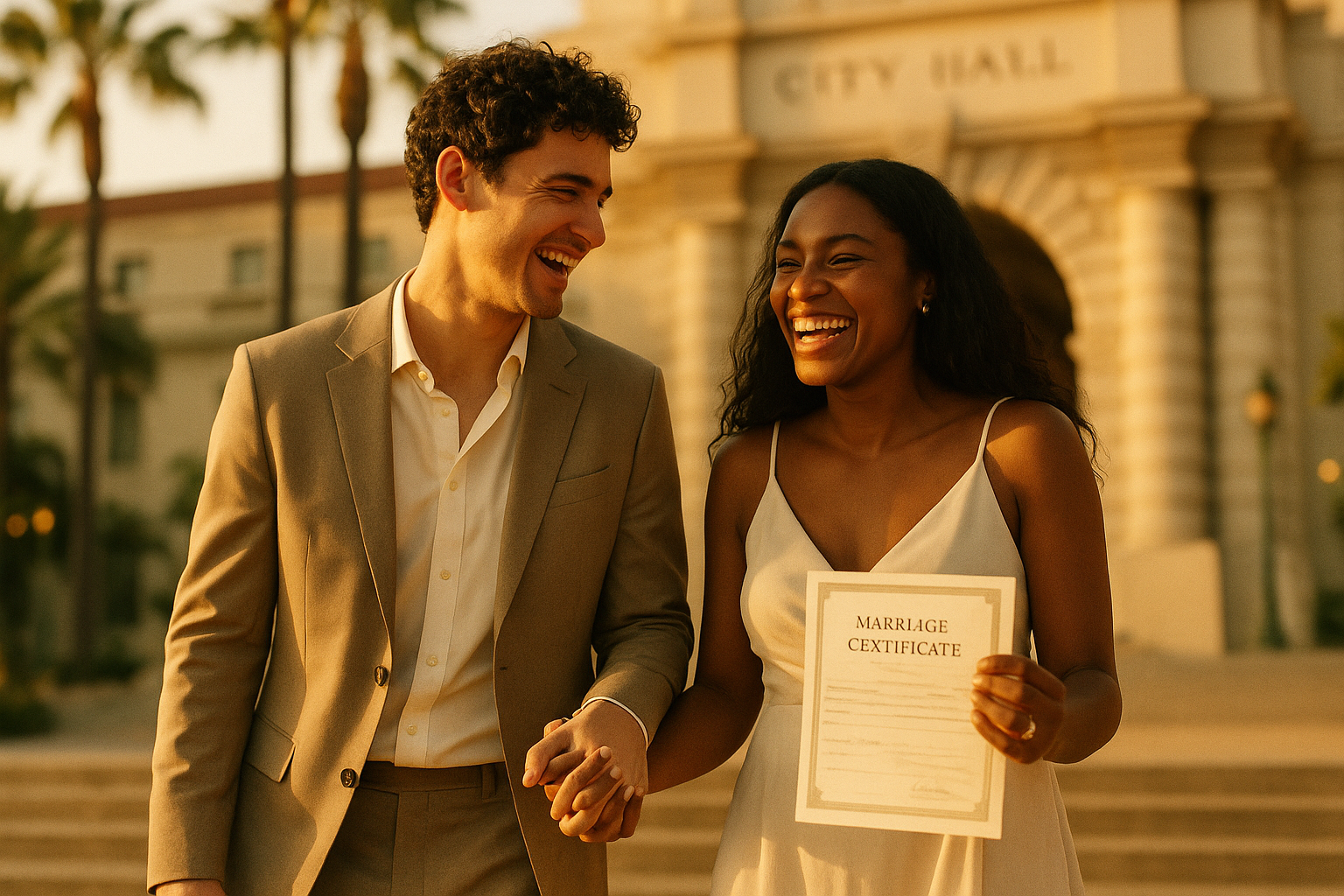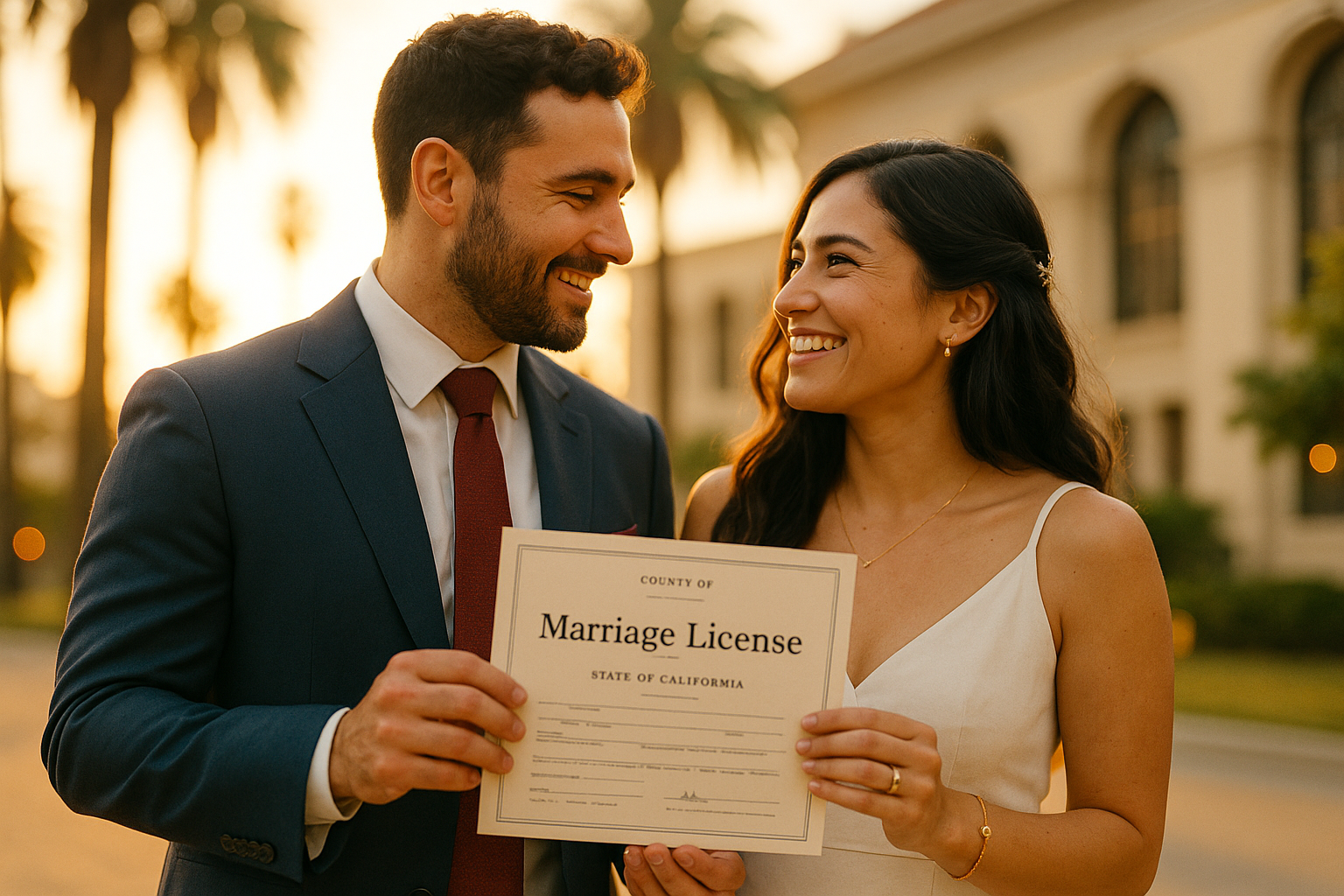
Somewhere in the middle of a same-day marriage appointment, between the ID check and the vows, you will be asked a question most couples have not thought about: what name do you each want to be known by after the wedding?
It sounds like small talk. It is not. Under California’s Name Equality Act, the answer you give in that moment is the legal name change — and it is the only moment the law gives you to make it. Here is what the license actually asks, what you are allowed to choose, and what happens if you leave the fields blank and change your mind next month.
Your name does not change automatically when you marry
California Family Code section 306.5 starts from a plain premise: parties to a marriage are not required to have the same name, neither party is required to change their name, and a person’s name does not change on marriage unless that person elects to change it.
That election happens in exactly one place — the “new name” fields on the marriage license application. One of you can use them, both of you can, or neither. Leaving them empty is a valid choice and the default.
What the law lets you choose
Section 306.5 is specific about the menu. You may change your last name, your middle name, or both. You may not change your first name this way.
Last name options
- The current last name of your spouse.
- The last name either spouse was given at birth.
- A single last name combining all or a segment of either spouse’s current or birth last name.
- A combination of both last names, hyphenated or not.
Middle name options
- The current last name of either spouse.
- The birth last name of either spouse.
- Your current middle name combined with your own or your spouse’s current last name.
- Your current middle name combined with either spouse’s birth last name.
Anything outside that list — a brand-new surname neither of you has ever carried, a first-name swap, dropping a middle name entirely — is not a marriage license entry. That route is a name-change petition in superior court, which is a separate process on a separate timeline.
The part that surprises people: there is only one window
The statute says the election may only be made at the time the marriage license is issued, and that once the certificate has been registered by the local registrar it may not be amended to add a new name or to change the name that was adopted. County clerks say the same thing in plainer language: San Diego County’s clerk states that parties may not add or amend this information after the marriage license has been issued, and Los Angeles County’s clerk notes that changing a name through this process can only be done at the time the license is issued.
Two practical consequences follow.
- Blank means no change. If the fields are empty and six months later one of you wants the other’s surname, the marriage certificate will not accomplish it. At that point the options are a court petition or, over time, common-law usage — neither of which is the quick paperwork the license would have been.
- Changing your mind after the license is issued means a new license. If the license already exists and one of you wants a different entry, the county’s answer is a replacement license, with the original voided.
There is one narrow exception, and it is not a second chance at the decision. If what was typed into the new name field does not match what you wrote on the application, that is a clerical error. The statute defines it as a mistake by the county clerk, a deputy clerk, or a notary authorized to issue confidential marriage licenses, and it is corrected by an amendment signed by one spouse and the clerk. It fixes a typo, nothing more.
Settle it before the appointment, not during it
A same-day wedding runs on momentum, and fifteen minutes before the ceremony is a poor time to work out whether you want to be hyphenated. Before you arrive, each of you should be able to answer three questions without hesitating:
- Am I changing my last name, my middle name, both, or neither?
- Exactly how is the new name spelled — including whether there is a hyphen, a space, or nothing at all between two surnames?
- Does that spelling match how I want it to read on my driver’s license, my passport and my bank records?
Write the answer down and bring it with you. The spelling that lands on the license is the spelling that propagates to every agency afterward, and a stray hyphen is exactly the kind of detail that sends someone back to a counter weeks later. Our how it works page walks through the rest of the appointment, so the name decision is the only thing you have to arrive with.
Your marriage certificate is the name change document
Once a new name is elected on the license, no separate court order is needed to prove it. Section 306.5 says the election itself serves as the record of the name change, and that a certified copy of the marriage certificate showing the new name constitutes proof that using it is lawful. The same certified copy is accepted by the DMV as identification establishing a true, full name.
Which means the certified copy is the document that does all the work — so order more than one. Los Angeles County’s clerk points out that the marriage certificate is used by many local, state, federal and private agencies, each with its own rules about what it will accept, and some of them keep what you send. Our FAQ covers when the county issues your certificate and how to request additional certified copies later.
One wrinkle if you are marrying on a confidential marriage license, which is what most same-day appointments use: under Family Code section 511, a confidential marriage record is not open to public inspection except on a court order. The privacy is the point of that license type, but it also means requesting copies is a job for the two of you rather than for anyone else who might otherwise handle it. Worth planning for before an employer’s HR team asks for one.
After the certificate arrives
The certificate is the authority; every agency still has its own queue and its own form. Social Security, the DMV, the passport agency, banks, payroll, insurance. Our step-by-step guide to name changes after marriage in California covers the order that causes the fewest headaches.
Getting married this week
We are authorized to issue a California confidential marriage license on site, and we file the paperwork with the county registrar, so the name decision, the license and the ceremony all happen in one appointment. Packages and current pricing for each of our offices and chapels are listed on our locations pages.
Come with the spelling agreed, and the rest takes about as long as the ceremony does.
Book your same-day marriage appointment →
This article describes California’s marriage license process and is not legal advice. For questions about your own situation, the county clerk’s office that issues your license is the authority on its own forms.